Social Media Analytics on Financial Information and Misinformation

Dr. Richard M. Crowley

https://rmc.link

Firm tweets

“Discretionary Dissemination on Twitter” (CAR 2024)

With Wenli Huang and Hai Lu

Questions

  • How do firms use Twitter for financial dissemination?

Hypothesis

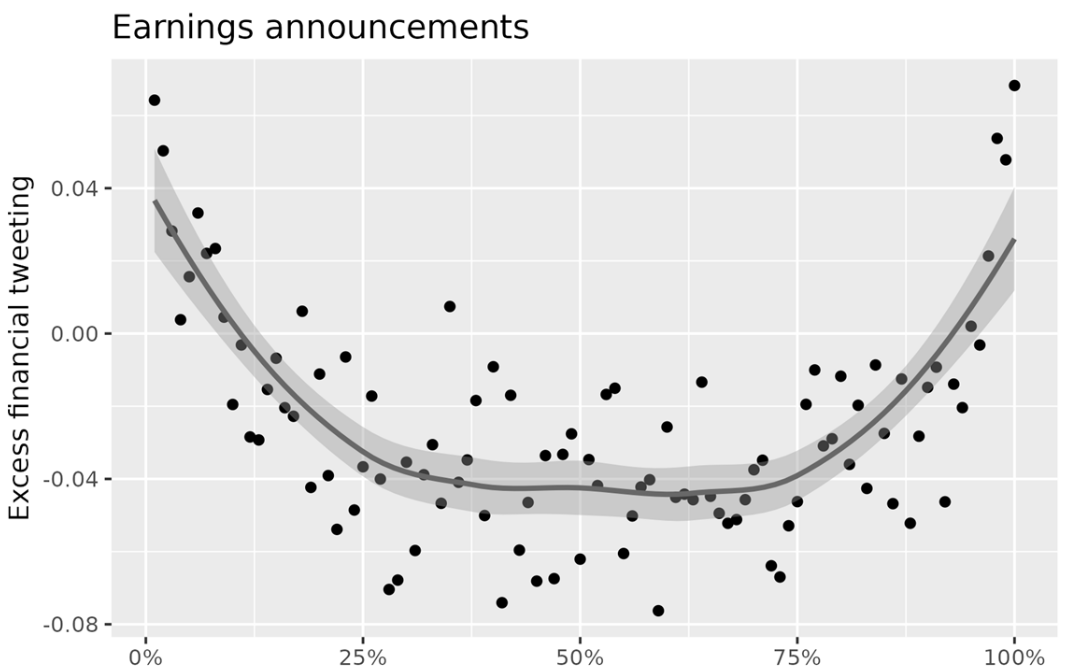
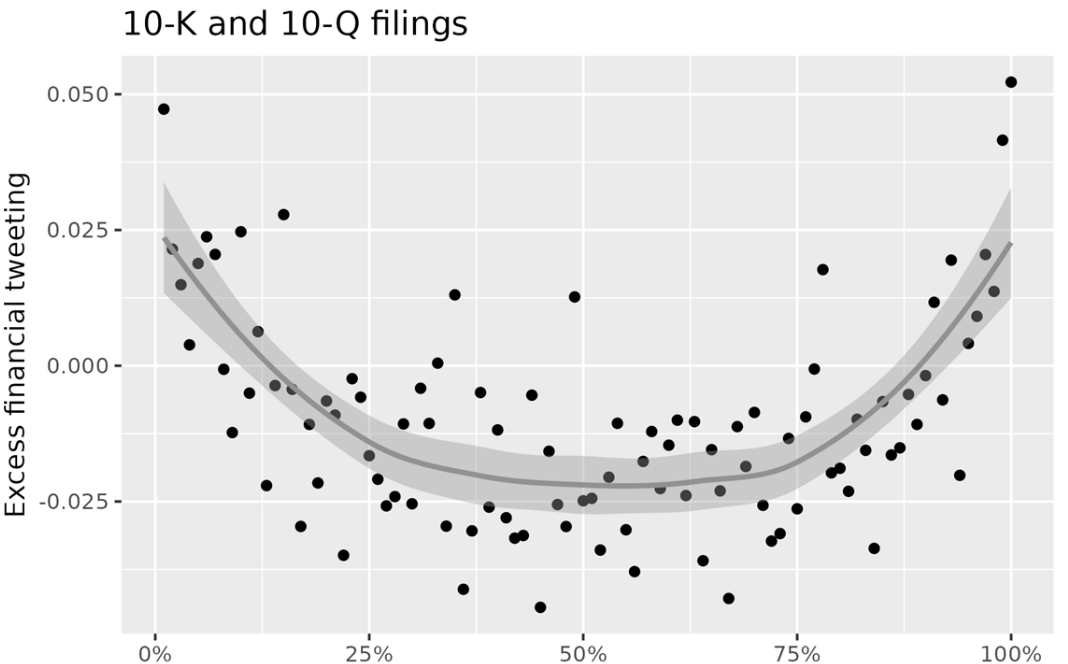
The likelihood of posting financial tweets increases with the materiality of accounting news events, irrespective of the direction of the news (positive or negative).

Firms post financial tweets more often around more material accounting news

  • This is irrespective of the direction of the news (positive or negative)
  • A loose test of theory: Hummel, Morgan, and Stocken (2024 RAND)

Example firm financial tweets

Classifying tweets

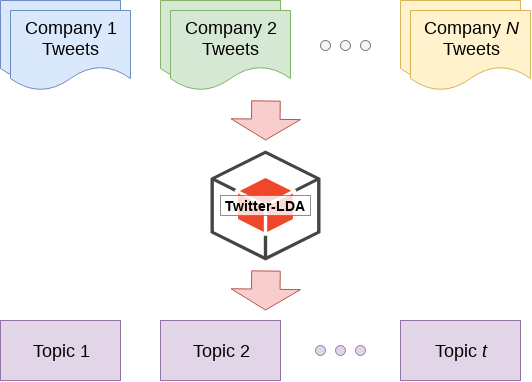
  • Classify using Twitter-LDA
  • Identify 60 topics
    • 1 financial topic
    • 42 nonfinancial topics
      • Business, conferences, marketing, and support
    • 17 other topics

Number Topic Top_words
23 Financial market, growth, markets, trading, earnings, global, report, quarter, results, energy
2 Nonfinancial: Marketing #shareacoke, make, #tastethefeeling, gifs, reply, mistletoe, happy, tweets, #makeithappy, hashtag
12 Other el, paso, police, trump, obama, man, city, donald, news, york

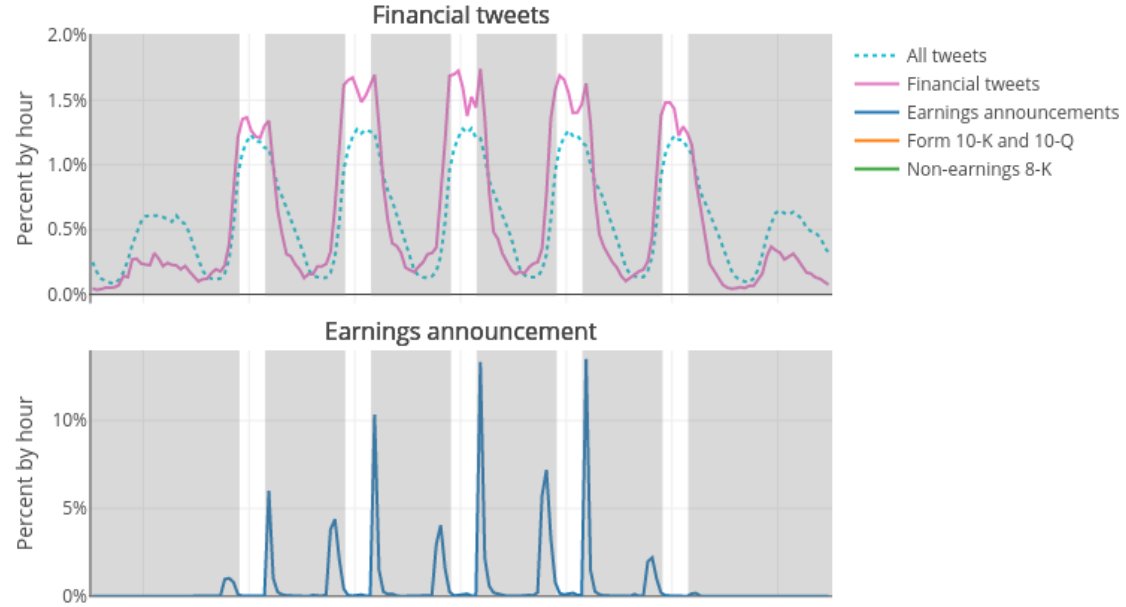
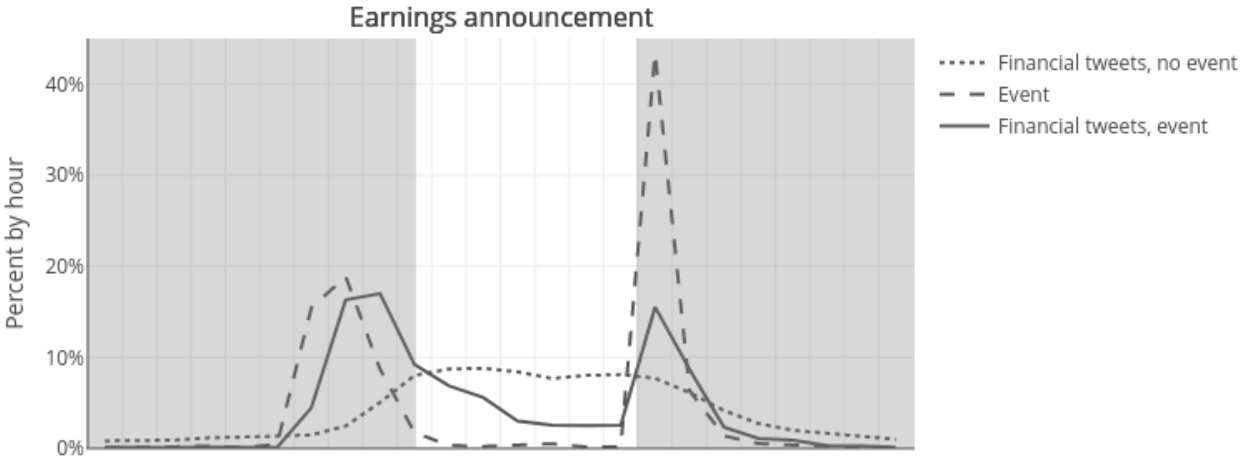
Tweeting behavior intraday

Financial tweets and Financial events

Financial tweets and event direction

CEO and CFO tweets

“Executive tweets”

With Wenli Huang and Hai Lu

Question 1

  • Does the market react to executives’ posts on Twitter
    • After controlling for firm disclosure on Twitter
  • If the market reacts, why do they react?

Mechanisms

  1. New information: Executives post new information and the market responds to this
  2. Perceived credibility: The identity of the account being a person, as opposed to the firm, drives the effect
    • Derived from social identity theory
    • Experimental and survey evidence is consistent with this

Only to the most investor-relevant tweets see a reaction

  • Modest support for the new information mechanism
  • Stronger support for perceived credibility mechanism

Example financial exec tweets (Business)

Example non-financial exec tweets

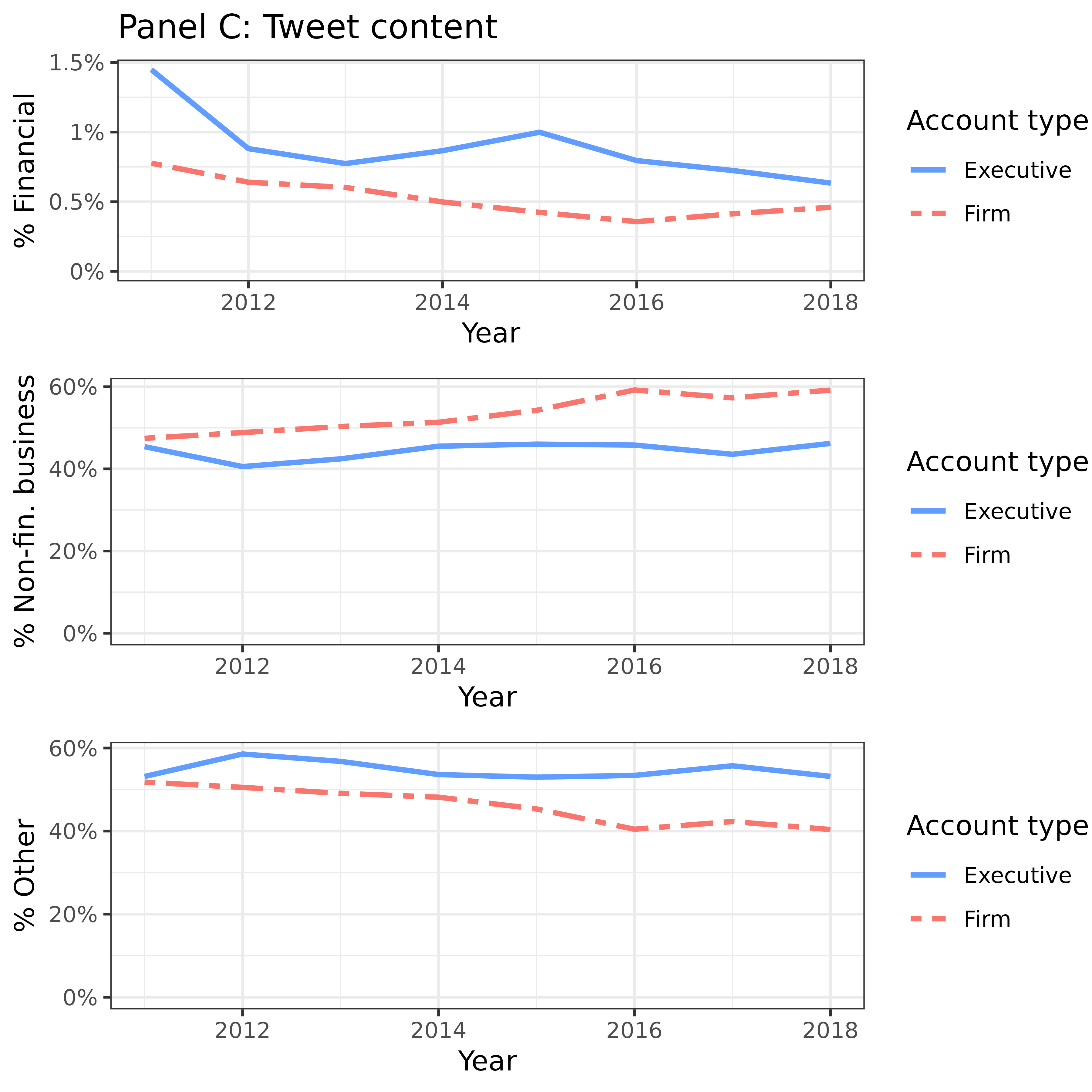
Tweet content over time

Executives Drive Stock Returns

\[ \scriptsize \begin{array}{l c c c c c} \hline \text{Variable} & \left|MMR_{t}\right| & MMR_{t} & Abn\ Vol_{t} & Abn\ Retail_{t} & Retail\ BSI_{t}\\ \hline \text{Fin tweets, Exec} & 0.004^{***} & 0.002^{*} & 0.416^{***} & 0.031^{**} & 0.012^{**}\\ & (4.65) & (1.88) & (4.77) & (2.20) & (1.99)\\ \text{Non-Fin tweets, Exec} & 0.000 & -0.000 & -0.002 & 0.002 & 0.001 \\ & (1.00) & (-0.96) & (-0.84) & (1.29) & (1.31)\\ \text{Other tweets, Exec} & -0.000^{***} & -0.000 & 0.000 & -0.000 & -0.001^{*} \\ & (-4.19) & (-0.38) & (0.41) & (-0.30) & (-1.70) \\ \text{Firm tweet measures} & \text{Yes} & \text{Yes} & \text{Yes} & \text{Yes} & \text{Yes}\\ \text{Controls} & \text{Yes} & \text{Yes} & \text{Yes} & \text{Yes} & \text{Yes}\\ \text{Firm, Exec, Year, and Month FE} & \text{Yes} & \text{Yes} & \text{Yes} & \text{Yes} & \text{Yes}\\ \hline \end{array} \]

What does this tell us?

  1. Most executive tweets don’t impact markets: ~99% of all tweets are non-financial business or “other”
  2. Financial tweets appear to be investor relevant

Corroborating evidence

Tweet sentiment

\[ \scriptsize \begin{array}{l c c} \hline \text{Variable} & MMR_{t} & Retail\ BSI_{t}\\ \hline \text{Fin tweets, Exec} & & \\ \quad\text{Non-neg} & 0.002^{**} & 0.013^{**}\\ & (1.87) & (2.18) \\ \quad\text{Negative} & -0.001 & 0.002\\ & (-0.23) & (0.09) \\ \text{All controls} & \text{Yes} & \text{Yes}\\ \text{Full FEs} & \text{Yes} & \text{Yes}\\ \hline \end{array} \]

Intraday posting time

\[ \scriptsize \begin{array}{l c c} \hline \text{Variable} & MMR_{t} & Abn\ Vol_{t}\\ \hline \text{Fin tweets, Exec} & & \\ \quad\text{Before trade} & 0.004^{***} & 0.492^{***}\\ & (3.98) & (5.09) \\ \quad\text{During trade} & 0.004^{***} & 0.258^{***}\\ & (2.56) & (2.71) \\ \text{All controls} & \text{Yes} & \text{Yes}\\ \text{Full FEs} & \text{Yes} & \text{Yes}\\ \hline \end{array} \]

What does this tell us?

  1. The signed return result may be due to the greater reaction to non-negative tweets
  2. Reaction to tweets posted before trading rules out endogeneity of executives posting in response tostock movement

Methodology: Disentangling mechanisms

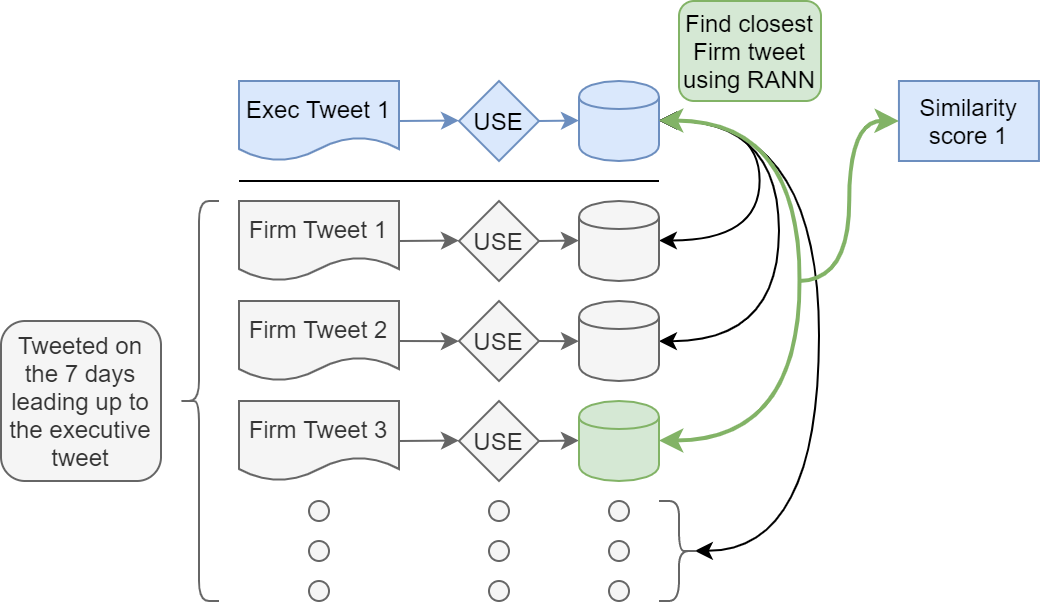
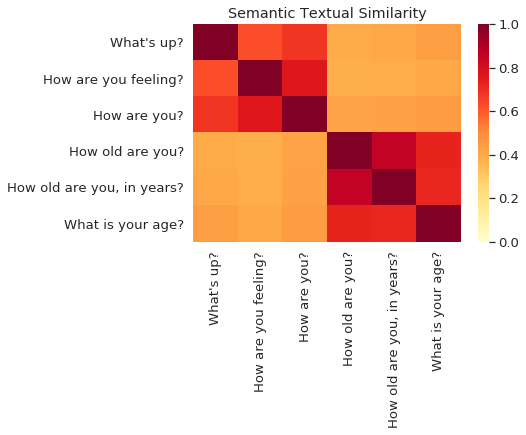
We identify how content-wise similar each exec tweet is to corresponding firm tweets via Universal Sentence Encoder (USE).

USE is a neural network method that relies on word meaning and word order to determine sentence meanings. It does not rely on word choice.

Methodology: Disentangling mechanisms

  • Three cases to consider for executive tweets:
    1. Not matched to a preceding firm tweet – most likely to have new information
      • Reaction to these tweets is consistent with the new information mechanism
    2. Preceded by firm tweets that are not similar
      • Reaction to these tweets is consistent with the new information mechanism
    3. Preceded by firm tweets that are similar – least likely to have new information
      • Reaction to these tweets is consistent with the perceived credibility mechanism

Empirical approach

  1. New information: Test the effect of unmatched tweets
  2. Perceived credibility: Within matched tweets, examine how similarity affects market reaction

Market Reaction Mechanisms

New information

\[ \scriptsize \begin{array}{l c c} \hline \text{Variable} & MMR_{t} & Retail\ BSI_{t}\\ \hline \text{Unmatched exec} & 0.003^{*} & 0.029^{**}\\ \text{fin tweets} & (1.86) & (2.28) \\ \text{Matched exec} & 0.004^{***} & 0.010^{*}\\ \text{fin tweets} & (4.72) & (1.77) \\ \text{All controls} & \text{Yes} & \text{Yes}\\ \text{Full FEs} & \text{Yes} & \text{Yes}\\ \hline \end{array} \]

Perceived credibility

\[ \scriptsize \begin{array}{l c c} \hline \text{Variable} & MMR_{t} & Abn\ Vol_{t}\\ \hline \text{Fin tweets, Exec} \times & 0.021^{**} & 2.205^{***}\\ \quad\text{Similarity} & (2.56) & (5.55) \\ \text{Main effects} & \text{Yes} & \text{Yes}\\ \text{All controls} & \text{Yes} & \text{Yes}\\ \text{Full FEs} & \text{Yes} & \text{Yes}\\ \hline \end{array} \]

What does this tell us?

  • New information: Tweets that are most likely to have new information lead to some market reaction
  • Perceived credibility Tweets that are more likely to repeat existing information lead to market reaction

What about misinforation?

“Misinformation Regulations: Early Evidence on Corporate Social Media Strategy” (RAST, Forth)

with Yun Lou, Samuel Tan, and Liandong Zhang

Questions

  • How do misinformation regulations affect corporate dissemination on social media?

Hypothesis

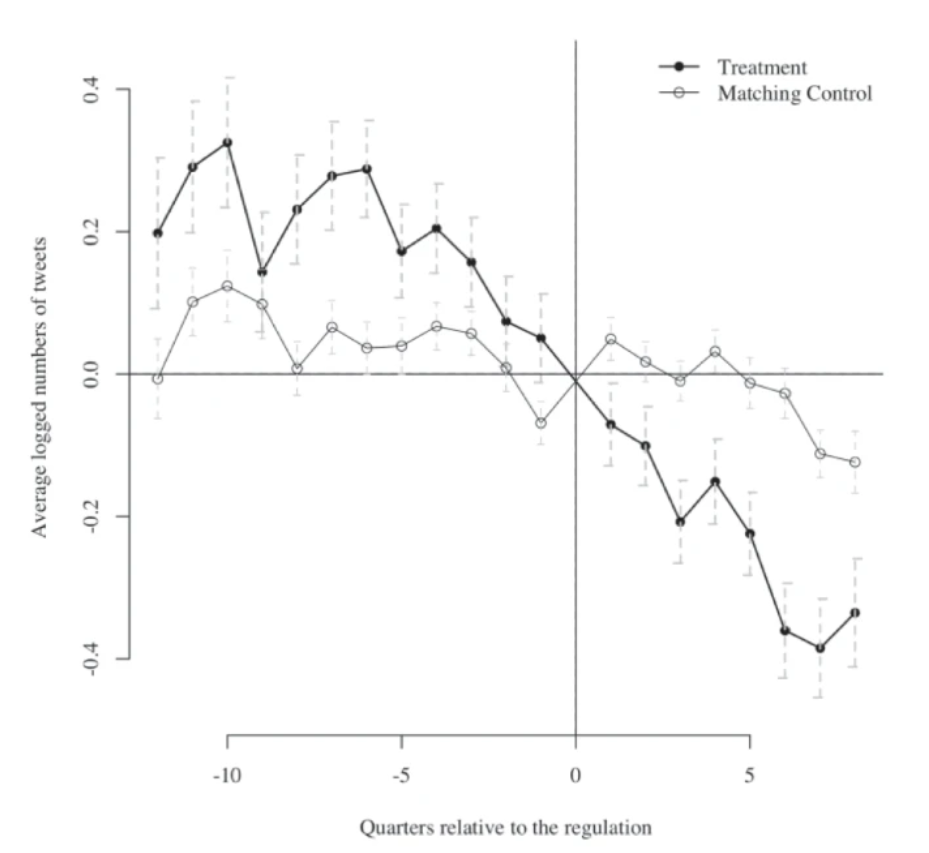
  • Defensive tweets: Companies will decrease their use of social media after misinformation regulations are implemented

We find results consistent with lessening of defensive behavior

  • More pronounced for countries with:
    • Higher social media usage
    • Greater investor protections
  • More pronounced for firms that are less transparent
  • Stronger for regulations that have criminal penalties or that focus on broader education of the population

Main result

Defensive tweets

“There have been rumours that DBS’ digibanking service disruption is linked to the sale of treasury bonds by Myanmar’s National Unity Government. There is no truth to this. DBS has not sold any such bonds.”DBS, 2021

\[ \scriptsize \begin{array}{l c c} \hline \text{Variable} & Defensive\ tweets & Industry\ tweets\\ \hline \text{Treat} \times \text{Post} & -5.140^{***} & 0.631^{***}\\ & (0.887) & (0.487) \\ \text{Controls} & \text{Yes} & \text{Yes}\\ \text{Quarter, Regulation, Country FEs} & \text{Yes} & \text{Yes}\\ \hline \end{array} \]

What does this tell us?

  • This test provides direct evidence that firms need to be less defensive after misinformation regulations are implemented

Pushing econometrics with DoubleML

  • Our main test design is pretty standard: Stacked DiD
    • Stacked: Construct individual panels around each treatment
    • DiD: Compare pre vs post event periods
  • The above assumes:
    1. Treatment is exogenous to control variables
    2. Controls have a linear effect on outcomes

Introducing DoubleML

Two stage non-parametric estimation of average treatment effects
  1. Models endogeneity of the treatment in a non-parametric manner
  2. Non-parametric models controls

Thanks!

Questions?


Dr. Richard M. Crowley
rcrowley@smu.edu.sg
@prof_rmc
rmc.link/

Packages used for these slides

  • downlit
  • ggplot2
  • ggthemes
  • gridExtra
  • kableExtra
  • knitr
  • quarto
  • revealjs
  • tidyverse

References

  • Crowley, Richard M., Wenli Huang, and Hai Lu. “Discretionary dissemination on Twitter.” Contemporary Accounting Research 41, no. 4 (2024): 2454-2487.
  • Crowley, Richard M., Wenli Huang, and Hai Lu. “Executive tweets.” (2025).
  • Hummel, Patrick, John Morgan, and Phillip C. Stocken. “Voluntary disclosure of verifiable information with general preferences and information endowment uncertainty.” The RAND Journal of Economics 55, no. 4 (2024): 519-549.
  • Crowley, Richard M., Yun Lou, Samuel T. Tan, and Liandong Zhang. “Misinformation regulations: Early evidence on corporate social media strategy.” Review of Accounting Studies (Forthcoming).